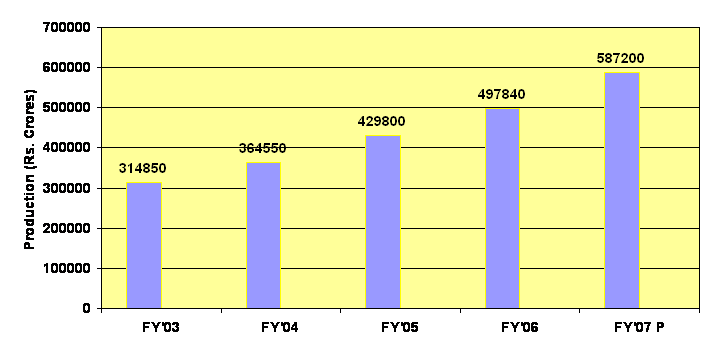
Small and Medium Enterprises (SME’s) in India constitute an important segment of Indian economy. The contribution of SME’s alone has been greater than 7% to GDP and 45% to Industrial production. It is also the second largest provider of employment after agriculture. SME’s also contribute to 40% of total exports directly and a significant amount of exports indirectly through large trading houses or third parties. The SME’s are dominant players in some of India’s major export sectors namely Textiles and Garments, Leather products, Sports goods, Gems and jewelry, Handicrafts among others. They also contribute substantially in industrial goods segments in sectors such as electrical, engineering, rubber and plastics.
I.1 Profile of Indian MSME Sector
S.No.
Particular
Value
1
Number of micro and small enterprises
130 Lakhs
2
Employment
410 Lakhs
3
Share in GDP
8-9%
4
Share in manufacturing output
45%
5
Share in exports
40%
I.2 Growth in number of SME units
Financial Year
Registered (In Lakhs)
Unregistered (In Lakhs)
Total (In Lakhs)
FY’ 03
16
93
109
FY’04
17
97
114
FY’05
18
100
119
FY’06
19
104
123
FY’07 P
20
108
128
1.3 Total employment by SME’s
Financial Year
Employment (In Lakhs)
FY’ 03
263.7
FY’04
275.3
FY’05
287.6
FY’06
300.0
FY’07 P
312.5
1.4 Production by SMEs
Source: Ministry of Micro, Small and Medium Enterprises
Administrative framework for MSME’s
Government of India has set up a new governing body for promotion and development of Micro, Medium and Small Scale Enterprises via “MSME Development Act”, which came into force from 2nd October 2006. The President under Notification dated 9th May 2007 amended the Government of India (Allocation of Business) Rules, 1961. by which, Ministry of Agro and Rural Industries (Krishi Evam Gramin Udyog Mantralaya) and Ministry of Small Scale Industries (Laghu Udyog Mantralaya) have been merged into a single Ministry, namely, “Ministry of Micro, Small and Medium Enterprises”.
The Ministry of “Micro, Small and Medium Enterprises” (MSME) is the administrative Ministry in the Government of India for all matters relating to Micro, Small and Medium Enterprises. It designs and implements policies and programmes through its field organizations and attached offices for promotion and growth of MSME sector. The Office of the Development Commissioner (MSME) is an attached office of the Ministry of MSME, and is the apex body to advise, coordinate and formulate policies and programmes for the development and promotion of the MSME Sector. The office also maintains liaison with Central Ministries and other Central/State Government agencies/organizations financial institutions.
Definition of MSMEs in India
Enterprises are broadly classified into two categories:
manufacturing; and
those engaged in providing/rendering of services.
Both categories of enterprises have been further classified into micro, small, medium and large enterprises based on their investment in plant and machinery (for manufacturing enterprises) or on equipments (in case of enterprises providing or rendering services). The present ceiling on investment to be classified as micro, small or medium enterprises is as under:
Manufacturing Sector
Enterprises
Investment in plant & machinery
Micro Enterprises
Does not exceed twenty five lakh rupees
Small Enterprises
More than twenty five lakh rupees but does not exceed five crore rupees
Medium Enterprises
More than five crore rupees but does not exceed ten crore rupees
Service Sector
Enterprises
Investment in equipments
Micro Enterprises
Does not exceed ten lakh rupees:
Small Enterprises
More than ten lakh rupees but does not exceed two crore rupees
Medium Enterprises
More than two crore rupees but does not exceed five core rupees
India SME exports
SME’s constitute an important segment of India’s industrial production with a contribution to 33% of its exports. During FY’ 03-06, India’s total merchandise exports in US dollar terms witnessed a CAGR growth of 25%, while in the same period SME exports grew at a CAGR of 24%. The remarkable contribution of SME’s in generating employment in the country has been instrumental in addressing issues pertaining to poverty and inequality of income. As per the Third All India Census on Small Scale Industries-2001-02, highly populated states such as Madhya Pradesh, Uttar Pradesh, West Bengal, Maharashtra, Karnataka and Jharkhand together contributed to around 55.4% of the total exporting units in India. In terms of distribution of value of exports from the SME sector, states like Punjab, Haryana, Uttar Pradesh, Tamil Nadu and Maharashtra together contributed 64.75% of total exports
Composition of SSI export basket from India
The composition of export basket of SME’s in India has both traditional and non-traditional commodities in nature. There are few commodity groups which are exclusively exported by SME’s such as sports goods, cashew etc. In the commodity group of engineering goods, SME’s constitute around 40% of the total exports of this commodity group.
S.No.
Product Group
Total Exports
2002- ’03 (Rs. Crores)
Share of SSI Sector for 2002-’03 (Rs. Crores)
% share of SSI
(A)
NON TRADITIONAL
1
Engineering Goods
38,093.00
12,500.00
32.81%
2
Basic Chem. Pharmaceutical & Cosmetic products
21,701.00
9,659.12
44.51%
3
Chemical & Allied products
10,026.75
3,354.67
33.46%
4
Plastic products
4,469.78
1,862.56
41.67%
5
Finished Leather & Leather products
8,779.78
6,108.24
69.57%
6
Marine products
6,881.31
3,251.40
47.25%
7
Processed Foods
13,827.95
9,679.57
70.00%
8
Wool &Woollen Products
1,289.17
1,224.71
95.00%
9
Sports Goods
317.51
317.51
100.00%
10
Readymade Garments
26,005.39
23,404.85
90.00%
11
Synthetic &Rayon Textile
7,811.53
1,484.19
19.00%
12
Processed Tobacco, Bidi & Snuff
1,066.10
675.19
63.33%
13
Electronics & computers
52,100.00
9,860.00
18.93%
Total of Non Traditional Products (A)
192,369.27
83,382.01
43.34%
(B)
TRADITIONAL ITEMS
14
Cashew
2,014.77
2,014.77
100.00%
15
Lac
100.69
100.69
100.00%
16
Spices
1,790.00
515.05
28.77%
Total of Traditional Products (B)
3,905.46
2,630.51
67.35%
A + B
Total of {A} & {B}
196,274.73
86,012.52
43.82%
(C)
Other export items
56,515.24
-
A+B+C
Total exports from the country
252,789.97
86,012.52
34.03%
(Source: Office of the Development Commissioner (MSME) & Ministry of Commerce)
Similarly, SME’s in basic chemicals & pharmaceuticals finished leather and leather products and marine products account for around 44%, 69% and 50% of the export share in their respective commodity groups. In view of the Government of India’s ambitious target of average GDP growth rate of 9% during the 11th Five Year Plan, SME’s have to play a vital role in achieving this target. It is imperative for the government to address the major issues plaguing the sector and take further inclusive growth oriented policy initiatives to boost the sector. This includes measures addressing concerns of credit, fiscal support, cluster-based development, infrastructure, technology, and marketing among others. As mentioned earlier, SME’s constitute 34% of India’s merchandise exports and in order to increase India’s export share to the global trade, SME’s are expected to enlarge their scope manifold.